
A Taste of Slovenia – Where Culinary Heritage, Local Traditions and New Friendships Meet
From centuries-old wine cellars and family farms to hands-on baking workshops and a remarkable journey through historical cuisine, the Culinary Heritage Study Tour in Slovenia offered days filled with inspiration, unforgettable flavours and genuine hospitality.
The rolling vineyards, picturesque villages and welcoming family businesses of Slovenia’s Štajerska region provided a wonderful setting for this year’s Culinary Heritage Study Tour, organised together with the World Food Travel Association (WFTA) and its Taste of Place initiative.
Taking place from 22–26 October 2026, the tour brought participants to Ljubljana, Maribor and the surrounding countryside to discover how local food traditions, entrepreneurship and tourism can work together to create truly memorable experiences.
Following our successful study tour in Thy-Mors-Salling, Denmark, in 2025, this year’s collaboration with WFTA offered an excellent opportunity to exchange knowledge between our organisations and meet entrepreneurs who have built remarkable businesses around their local heritage.
And what a journey it became! At practically every stop, the group was welcomed with homemade specialities, wines produced on the surrounding hillsides and, perhaps most importantly, the personal stories of the people behind them. The days were packed with experiences, yet passed remarkably quickly thanks to good company, thoughtful organisation and the warm hospitality of our Slovenian hosts.
From Ljubljana to the wine hills of Štajerska
The experience began in Slovenia’s charming capital, Ljubljana, with a guided walk through its historic streets and a welcome dinner at JAZ by Ana Roš, the bistro associated with internationally acclaimed chef Ana Roš. It was a wonderful introduction to Slovenia’s culinary ambitions before the group continued to Maribor, which became the base for the following days.
The next morning brought a taste of Maribor’s coffee culture, followed by an excursion into the beautiful wine-growing landscapes of Slovenske gorice and Jeruzalem. Panoramic viewpoints, vineyard walks and a leisurely lunch at Taverna Jeruzalem offered a first glimpse of how deeply wine production is connected to the regional landscape and identity.
At the historic Vineyard Cottage Malek in Svetinje, the participants experienced another important part of this tradition: centuries of winemaking knowledge preserved through families, buildings and craftsmanship.
Family farming, living history and generous hospitality
Saturday introduced the group to some of the region’s most characteristic rural enterprises. A visit to Maribor’s Old Vine House and farmers’ market highlighted the importance of local products and the city’s famous vine, which has survived for more than four centuries.
At Domačija Firbas, the group encountered the genuine hospitality of a family-run agritourism business. Farm-produced specialities, tastings and an introduction to the family’s distillery showed how agriculture and tourism can complement each other while preserving the identity of the countryside.
The journey continued to Ptuj, Slovenia’s oldest town, where historic streets and impressive architecture provided another perspective on the country’s rich heritage.
However, some of the most remarkable experiences were still ahead, particularly those where passionate hosts invited the group behind the scenes to discover how their businesses had developed over generations.
Dreisiebner – wine, borderland history and a heart among the vineyards
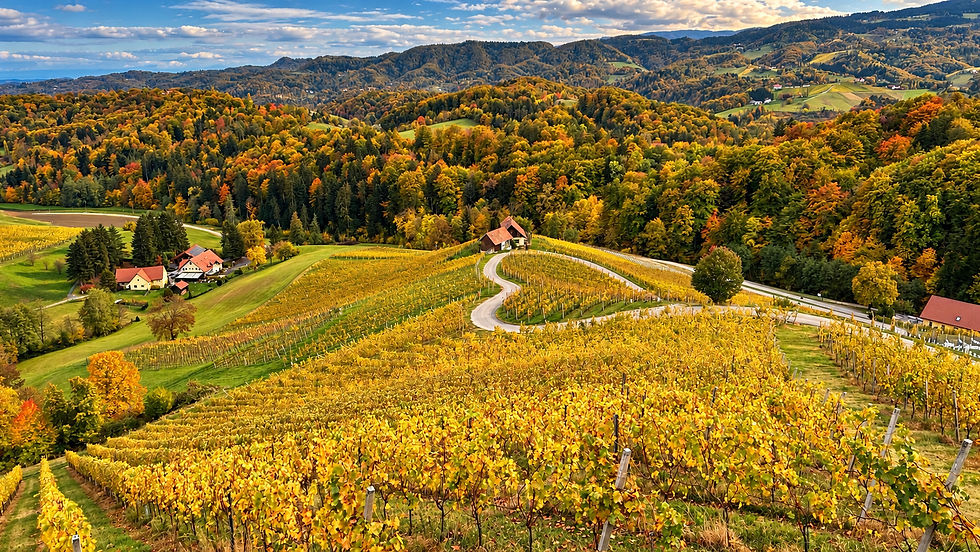
Few places could offer a more spectacular introduction than Dreisiebner Winery. Perched among the vineyards immediately along the Austrian-Slovenian border, the family estate offers breathtaking views across rolling hills covered with vines.
From the winery’s viewpoint, visitors discover a remarkable sight: a winding road forming an almost perfect heart shape through the vineyards. Interestingly, this romantic landmark was never deliberately designed as a symbol of love. The road was constructed to follow the landscape, and its unusual shape became an unexpected attraction. Today, it is among the region’s most photographed views and a particularly appealing destination for visiting couples.
But the beauty above ground is only half the story.
Behind the farm shop lies an extraordinary historic wine cellar, filled with wines, old objects and reminders of generations of winemaking. Moving through the vaulted spaces, it becomes clear that this is not simply a place to taste wine, but somewhere to experience history.
The winery’s position directly on the border has given the family many remarkable stories to share. During the communist period in former Yugoslavia, for example, the family’s tractor was reportedly parked on the Austrian side of the border overnight to keep it safe. Stories like this bring European history to life in a way that no conventional presentation could ever achieve.
Naturally, an excellent wine tasting accompanied the visit, with the family’s own wines served alongside local specialities. It was a wonderful combination of landscape, craftsmanship, hospitality and storytelling.
And fittingly, after exploring this fascinating borderland estate, the group briefly crossed into Austria before heading back into Slovenia for the evening’s next culinary experience.
Vrezner Winery – a star-filled evening, wild game and family wines
The evening continued at the family-run Vrezner Winery, where our hostess Milena welcomed the group in a wonderfully atmospheric setting.
By now, darkness had settled over the surrounding hills. As we travelled down through the vineyards, deer could be seen moving through the landscape, almost as though nature itself was preparing the setting for the evening ahead.
At the winery, the focus turned to generous local hospitality, wild game and wines from the family’s own production. With the night sky above and the vineyards surrounding us, the dinner became one of those experiences that perfectly illustrate what culinary tourism can achieve when food and its place of origin are inseparable.
There was no need for elaborate staging. The combination of personal hospitality, locally prepared food and genuine family stories made the evening special.
For the visiting entrepreneurs, it was another valuable example of how smaller, family-operated businesses can create experiences with a character and authenticity that larger establishments often struggle to reproduce.
Domačija Kapl – rolling up our sleeves for traditional Slovenian baking
Sunday brought one of the most enjoyable hands-on experiences of the tour at Domačija Kapl.
Here, the group was invited to prepare its own version of gibanica, a traditional Slovenian speciality that could perhaps best be described as a giant dessert pizza, generously prepared with sugar, cream, butter, cottage cheese and cinnamon.
Under the guidance of our hosts, participants rolled up their sleeves and discovered the techniques behind this delicious regional speciality. As with the cook-along during our previous Culinary Heritage Study Tour in Denmark, the workshop became much more than a cooking lesson. Working together, exchanging experiences and laughing over the results created another excellent opportunity for the group to bond.
The farm offered several other culinary discoveries as well. Its beehives provide honey for local products, while honey-based liqueurs and other homemade specialities demonstrate how a relatively small farm can diversify its production.
A particular highlight was the wine tasting in the intimate cellar, where the winemaker himself introduced his wines. Hearing directly from the person responsible for the production, learning about the challenges and choices behind each bottle, and tasting the results in the place where they were made added a dimension that simply cannot be recreated elsewhere.
The visit beautifully illustrated how traditional food, local production and personal interaction can become the foundations of an attractive tourism experience.
From herbs and tea to a journey through centuries of food history
The afternoon continued at Čajnica Kolarič, where the group explored another aspect of regional production through herbs, teas and the knowledge of host Danica Kolarič.
While wine is naturally a major part of Štajerska’s culinary identity, the region offers much more. Small-scale producers working with herbs, honey, fruit and traditional recipes contribute to the diversity that makes the countryside such an interesting destination to explore.
Yet the final visit of the day would take the group much further back in time.
Pri Baronu – a remarkable culinary journey into Europe’s past
High in the beautiful hills of Pohorje, Pri Baronu offered one of the most fascinating and memorable experiences of the entire journey.
The farm is a wonderful example of how history, organic agriculture, gastronomy and entrepreneurship can be combined into a unique concept.
Its story stretches back centuries, while the modern family’s hospitality business began in 1991, just as Slovenia regained its independence. The farm later became an early pioneer of certified organic farming, developing a philosophy built around the relationship between people, animals, plants and the land.
Today, farm animals, vegetable gardens, herbs, orchards and carefully managed growing areas form the foundation of the restaurant’s food production. Much of what appears on the plates comes directly from the farm itself, while other ingredients are obtained from nearby producers.
There is an impressive sense of purpose behind the entire operation. Sustainability is not simply a marketing expression here; it is part of the farm’s daily activities and its identity.
But what made this particular visit truly special was the HERITERRA historical dinner, a culinary experience designed around ingredients, cooking methods and food traditions from European history.
The concept is both simple and brilliant: imagine preparing an entire dinner using only ingredients that were available in Europe before Christopher Columbus reached the Americas in 1492.
That means no potatoes, no tomatoes, no maize and none of the other ingredients that later became familiar parts of European cuisine.
Instead, the kitchen draws inspiration from ancient grains, vegetables, herbs, meats and traditional preparations associated with different historical periods. Archaeological knowledge is combined with culinary creativity to reconstruct a fascinating journey through Europe’s food heritage.
The dishes were presented in traditional clay vessels and rustic tableware, contributing to the historical atmosphere. Yet the cuisine was far from outdated. The chefs had cleverly adapted the preparations to modern tastes, demonstrating how culinary heritage can be preserved and interpreted without losing its original character.
Accompanied by carefully selected wines, the five-course dinner was both educational and genuinely delicious.
The experience also demonstrated a particularly interesting business concept: turning historical research and agricultural heritage into a marketable culinary experience.
Pri Baronu has succeeded in making history something guests can actually taste. Its HERITERRA concept draws on archaeology, botany, organic farming and gastronomy to create something that is distinctive, meaningful and highly memorable.
For anyone involved in culinary tourism, destination development or heritage-based entrepreneurship, this is precisely the kind of place that makes a professional study tour so valuable.
Learning directly from the people behind the businesses
There is something particularly rewarding about visiting smaller food producers and family-run enterprises as part of an organised professional group.
Unlike ordinary tourists, participants in a Culinary Heritage Study Tour have the opportunity to discuss business models, production methods, marketing, challenges and opportunities directly with the owners.
Why did they develop a particular product? How do they attract visitors? How much of their production is sold directly? What difficulties have they encountered, and which decisions have proved successful?
These conversations can be invaluable for entrepreneurs looking to develop their own businesses.
Just as importantly, the exchange works both ways. Hosts often gain fresh perspectives from their international visitors, who bring experience from other countries, regions and business environments.
The result is not simply a tour of interesting places, but a genuine exchange of ideas and practical knowledge, with opportunities for new cooperation and friendships.
This is also one of the central purposes of the Culinary Heritage Study Tours: to turn inspiration into practical ideas that participants can bring home and apply in their own operations.
A special thank you to our Slovenian hosts and WFTA
The entire programme was very well organised by Rasto Kirn, WFTA’s local ambassador in Slovenia, whose knowledge of the region and close relationships with the hosts made a considerable difference.
From the family farms and winemakers to the restaurants and culinary workshops, the visits were thoughtfully arranged and delivered with the kind of personal attention that makes a demanding programme feel both enjoyable and rewarding.
It was particularly impressive how each host contributed something different to the overall experience, while the recurring themes of local production, tradition, sustainability and hospitality connected the journey into a coherent whole.
Our sincere thanks go to Rasto, the World Food Travel Association, all our wonderful Slovenian hosts and, of course, the enthusiastic participants who made the journey so enjoyable.
Slovenia – a destination worth returning to
After several days exploring the countryside around Maribor, one conclusion became increasingly clear: this part of Slovenia has enormous potential for authentic culinary tourism.
Its combination of beautiful landscapes, historic wine estates, innovative farmers, excellent local products and genuinely welcoming people creates an exceptionally attractive destination.
For Culinary Heritage, the visit also confirmed the value of cooperating with organisations such as WFTA, where different networks and experiences can complement each other and open doors to new knowledge and opportunities.
We are already considering bringing further groups to the Maribor region in the future. There are undoubtedly many more hidden gems waiting to be discovered, and the connections established during this study tour provide a valuable foundation for developing new experiences.
Our annual Culinary Heritage Study Tours continue to demonstrate that some of the most valuable learning happens not in conference rooms, but around kitchen tables, in farmyards, among vineyards and in conversations with passionate entrepreneurs.
Because culinary heritage is not only about preserving the flavours of the past. It is about the people who keep those traditions alive, develop them for the future and generously share them with others.
And that is exactly what we experienced in Slovenia.


Comments